
The project management profession is at a new crossroads. As reported by PMI, both the use of Agile and Waterfall approaches are in decline. Hybrid is on the rise. But it lacks clear usage patterns. AI will support but not supplant project activities.
Rather than pinning hopes on the next big thing or a new silver-bullet solution, project managers should return to the basics—proven foundational practices. This requires thoughtful, intentional decisions and disciplined follow-through.
The first article in this series discussed the state of the industry. The second recommended is to develop guiding principles to set the context and provide intent. This article describes how to select a project approach. Future articles will outline an execution framework and foundational practices.
Selecting the approach is a critical decision that is often unexamined. Teams frequently default to “what we always do,” the enterprise’s preferred or mandated option, or bow to the pressure of the loudest person in the room. The approach decision should be made carefully based on an assessment of the project’s context and specific needs.
Approach Options
Contents
There is an overwhelming variety of project management approaches available. By one count, there are at least 50 options. The choices are often summarized as a continuum with Predictive and Agile as endpoints and Hybrid options in the middle.
Predictive is often loosely defined as the “waterfall” or sequential approach. One phase follows another. At a high level, that is true. But dig a little deeper. There are competing international standards, and most large enterprises have developed proprietary processes and practices.
Scrum is often used synonymously with Agile. But it is not. And that creates problems. Scrum is the most popular framework that describes a set of roles, artifacts, and ceremonies (meetings) that enable the Agile Manifesto Values and Principles. However, Scrum is not always the “best” agile approach.
Kanban is valuable, difficult to categorize, and can improve various delivery methods. It is a set of principles and practices that encourage flow and can be used in projects and operations. Sadly, it is often overlooked as a standalone approach. For example, agile teams working on a systems migration project do not need to be limited by a fixed sprint length because they are not releasing functionality every two weeks.
“All projects are hybrid,” claims Jesse Fewell, Global Chair of PMBOK 8th Edition. In my series on hybrid project management, I described a palette of approaches, with Waterfall, Agile, and Lean/Kanban forming the endpoints of a triangle, and the interior space representing a blend of practices (Hybrid). Within the palette, patterns emerge. Hybrid-predictive projects emphasize predictive elements, while hybrid-agile projects emphasize adaptive aspects. Lean and Kanban components can be integrated into any project type.
Like artists mixing colors to create beautiful paintings, project managers should combine practices to achieve greater success. Successful hybrid projects require intentional design; they will not occur by accident.
Picking an Approach Pattern
The approach decision sets the trajectory and embeds key assumptions about how the project will be managed and executed, including governance, delivery cadence, team and stakeholder engagement, and more. These decisions may be inconsistent with the project’s needs or constraints, setting up internal conflicts. Examples abound. There are fixed-scope “agile” projects and Scrum projects that do not deliver functionality until the end.
There is no single agreed-upon method for choosing the approach. Models, decision trees, and rubrics are available. Deterministic tools can inform decisions and guide the process, but they can also be misleading and lead to poor choices. Tools are helpful, but do not replace sound judgment. Assessing the cost of change, understanding the clarity of the problem and solution space, and considering environmental factors provides a context-sensitive outcome.
Cost of Change
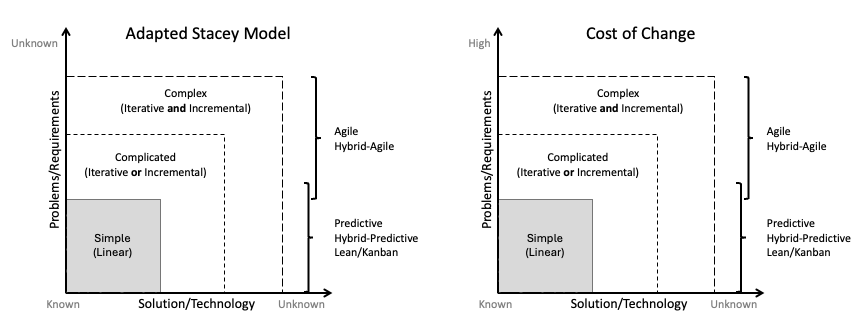
Understanding the cost of change can help determine the best overall approach for the project and for each phase. The cost of change measures how easy it is to modify or change a project deliverable. This is influenced by physical constraints as well as timing.
The Predictive approach supports projects with high change costs. Construction projects provide a ready example. The design and specifications are finalized and approved before construction begins. Once the concrete is poured, moving a pipe or conduit is costly.
Knowledge work projects often favor an adaptive (Agile) approach. Quickly developing solution increments, getting feedback, and adjusting is cost-effective. Agile software projects are successful due to short development cycles and regular customer feedback. High school teachers review term paper drafts for similar reasons. It is easier to test, fix, and adjust 10 lines of code than 1,000 lines of code.
Timing is also an important factor. Blending approaches (Hybrid) based on project type and phase is a common practice. For some types of projects, the cost of change may initially be low, but at a certain point, it becomes prohibitive.
During the design phase of a construction project, the cost of change is low. Architects meet regularly with stakeholders to review and adjust design ideas. Making changes to blueprints is easy and cheap. Changes during construction are expensive.
Problem and Solution Space
When starting a project, gaining an orientation of the landscape can be invaluable. The Cynefin and Stacey Models can provide guidance into the problem and solution space by framing the environment. They provide insight without prescribing decisions.
The Cynefin Model is a sense-making framework for the problem space where situations can be simple, complicated, complex, or chaotic. The Stacey Model builds on this orientation, adds the solution space, and recommends a development approach:
- Simple problems have well-understood requirements and solutions. A Predictive or Kanban approach is recommended for these projects. We know what to do, just do it.
- Complicated problems often have fewer clear requirements and solutions. A Predictive approach, where significant effort is invested in developing the solution, is commonly used for these types of projects. A Hybrid approach that employs iterative design and incremental delivery can also be effective.
- Complex problems have unclear requirements and solutions that require Agile’s iterative and incremental approach.
Environmental Factors
Environmental factors affect the project and are outside the team’s control. Examples include industry, regulatory environment, corporate culture, team experience, and risk appetite. Fully considering these environmental factors is essential for determining the approach.
Industries producing physical products, such as construction and defense, where the cost of change is high, tend to favor a more predictive approach. Software, finance, and other industries where the cost of change is lower can adopt agile practices.
Highly regulated industries, government work, and risk-averse cultures have constraints that require more structure, documentation, reviews, and approvals. Predictive approaches more natively support these needs, though hybrid-agile approaches can also be tailored to accommodate them.
An organization’s and a team’s preferences and experience can influence these decisions. Explicit policies and standards may specify the use of a particular approach. Team experience, or the lack thereof, can also favor one approach over another. Rigidity may persist even when a single approach or set of practices better fits a project’s needs.
© 2025, Alan Zucker; Project Management Essentials, LLC
See related articles:
- Back to Basics, Part 1: State of the Union
- Back to Basics, Part 2: Principles
- Hybrid Project Management: Part 3, Picking the Approach
- Project Frameworks: Understand the Choices
To learn more about our training and consulting services or subscribe to our newsletter, visit our website: http://www.pmessentials.us/.
Image generated by ChatGPT