
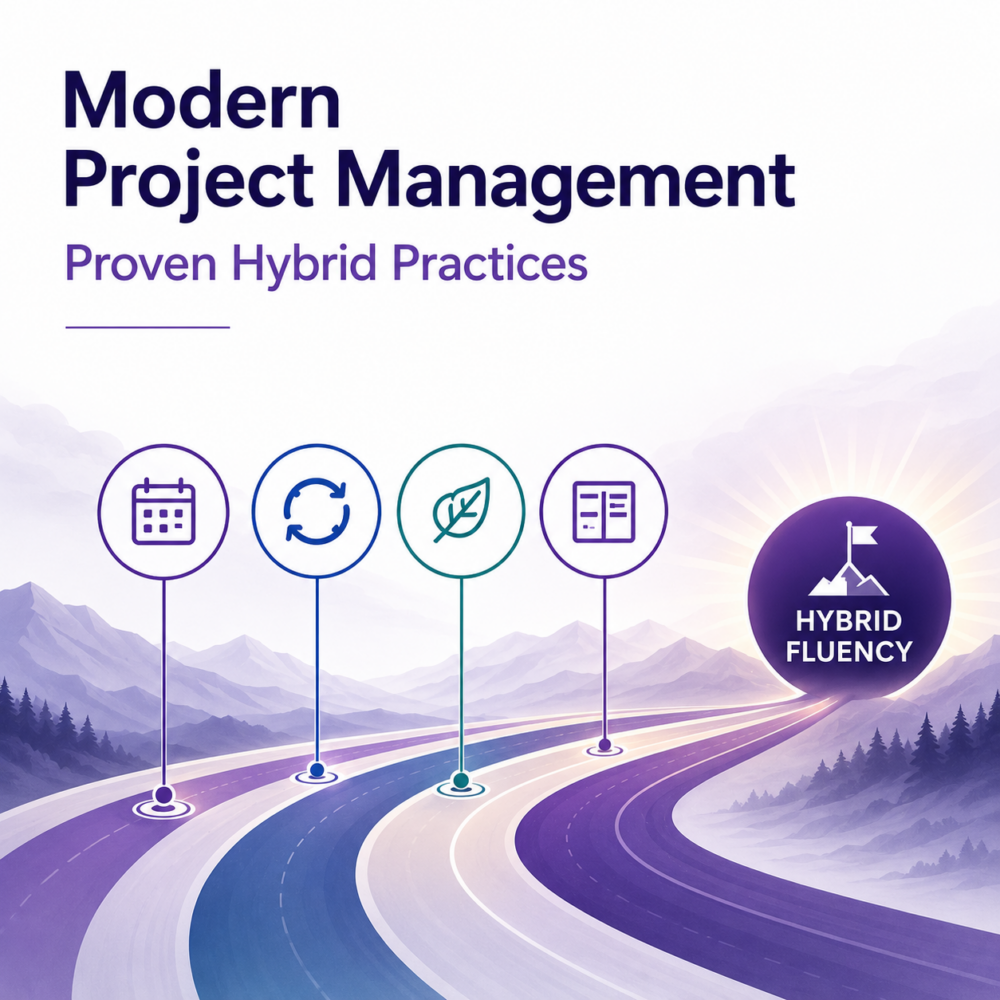
Project management is rapidly evolving. Our modern world is marked by uncertainty, ambiguity, and complexity. To succeed, project managers must anchor on basic principles and adopt proven methods from various approaches, frameworks, and strategies.
Jeff Bezos said in 2012 that he could not predict what the world would look like in ten years. His strategy was to build a business based on things that wouldn’t change. Consumers want low prices, fast delivery, and a large selection of items. Instead of worrying about the unknowns, Amazon focused on the pillars of certainty.
The project economy describes how organizations increasingly depend on projects to generate value beyond their usual operations. However, achieving success remains difficult. McKinsey estimates that large IT projects go over budget by 45%, miss their deadlines by 7%, and provide 56% less value than expected. Standish Group surveys found that, on average, only about a third of projects meet the triple constraints. PMI’s newly introduced Net Project Success Scoreindicates the industry average is an unimpressive 36 out of 100.
Organizations are shifting from Predictive and Agile to Hybrid approaches, according to PMI.
Capterra’s latest global survey finds hybrid adoption at 41 percent, nearly double the 2021 figure. AI will further disrupt how projects are estimated. Gartner predicted that 80 percent of today’s project management tasks could be automated by 2030.
What should project managers do? Follow Amazon’s lead. Concentrate on what we know is important and will not change.
We know what stakeholders want. They seek value from their investment. They prioritize predictability—knowing how much and when. They also desire flexibility—recognizing that priorities and needs will change, and the project must adapt accordingly.
We should prioritize proven, well-known practices that lead to project success rather than rigidly adhering to a specific approach, framework, or methodology. Be intentional. Make decisions based on the context. Focus on the basics and execute flawlessly.
Building Hybrid Fluency
Project approaches are often viewed as a spectrum, with Predictive and Agile at the extremes and Hybrid in the middle. A broader view shows a triangular palette of project management styles, with Lean and Kanban serving as the third legs. The interior area reflects the many available options.
Most project managers are proficient with Predictive practices. Building hybrid fluency means adding Lean, Agile, and Kanban to their foundational knowledge base.
Alistair Cockburn and Martin Fowler—two of the Agile Manifesto signatories—describe using the ancient Japanese Shu-Ha-Ri model to illustrate how expertise develops. In the Shu stage, you follow the mechanics of frameworks and practices. Once you become proficient, you start adjusting practices during the Ha stage. At the Ri stage, you go beyond individual frameworks and practices.
Hybrid fluency is about understanding and appreciating the rich tools and practices at our disposal. It is defining options and seeing opportunities to deliver projects more effectively.
The following principles, practices, and frameworks are the building blocks of hybrid fluency:
Lean evolved from manufacturing and outlines a set of principles for organizing work. The focus is on delivering value and minimizing waste. Lean emphasizes the importance of leadership, empowerment, continuous improvement, and flow in reaching these objectives.
Adopting a Lean mindset allows project managers to look beyond just delivering a solution and to understand the entire process. It fundamentally transforms how we lead and manage, encouraging us to unlock the full potential of our teams.
Value streams trace a customer’s journey. The journey begins with a customer’s need and ends with it being fulfilled. The customers may be external or internal. Adopting a customer-centric view and mapping their experience allows us to identify opportunities to reduce waste and improve value delivery.
Kanban is a set of principles that focus on creating flow. Kanban can help individuals and teams be more effective by emphasizing delivering value rather than just staying busy. Any project team can benefit from Kanban and visual project management practices.
Scrum is the most common Agile framework and defines a set of practices and roles that enable agility. Scrum teams deliver value in short increments (sprints) that are generally 2-weeks long. They receive feedback from their stakeholders and customers that informs future development.
Scrum practices improve project success. The team is empowered and actively engaged in delivering the solution. Short development cycles foster a sense of urgency. The inspect-and-adapt loop ensures alignment with stakeholder expectations.
The Scaled Agile Framework (SAFe) is designed to support program- and enterprise-level initiatives. It uses cadence (coordinated 2-week delivery cycles) and synchronization (quarterly big-room planning) to manage the efforts of multiple Agile teams. As a comprehensive framework that incorporates multiple principles and practices, it is increasingly adopted by large corporations and government agencies.
Disciplined Agile is an approach-agnostic toolkit—a curated repository of project management practices. Instead of being haphazard, project managers and teams can use this toolkit to be deliberate in improving their ways of working.
The Agile Value Management Office (VMO) applies Lean/Agile principles and practices to portfolio management and enterprise value delivery. It centers on four key themes:
- Value acceleration. Delivering measurable business value while enabling organizational agility,
- Lean portfolio management. Efficiently allocating resources and reducing waste through value streams,
- Adaptive governance and risk management. Enabling dynamic decision-making while actively mitigating risk, and
- Strategic alignment and execution. Supporting organizational goals and improving execution.
Amazon built its strategy on the constants. Project management can do the same. New tools, methodologies, and frameworks will be created. Best practices will keep evolving. Instead of chasing trends, successful project managers build their work on proven hybrid practices and principles.
The Modern Project Management: Proven Hybrid Practices course was designed to help project managers develop fluency in Lean, Agile, and Kanban practices. You cannot become an expert in a day, but you can learn where to look and what to do. Understanding the options, seeing proven tools in practice, and recognizing the possibilities will drive better outcomes.
© 2026, Alan Zucker; Project Management Essentials, LLC
See related articles:
- Back to Basics, Part 2: Principles
- Back to Basics, Part 3: The Approach
- Disciplined Agile & SAFe
- Hybrid Project Management: Part 1, What is Hybrid?
- Hybrid Project Management: Part 4, Picking the Practices
- Project Frameworks: Understand the Choices
- Scrum vs. Kanban: What to Choose?
To learn more about our training and consulting services or subscribe to our newsletter, visit our website: http://www.pmessentials.us/.