
Project success remains elusive despite the array of methodologies, frameworks, practices, and tools available. Better outcomes will come from mastering and consistently executing foundational practices. Data from PMI, Wellingtone,CMMI, and other sources demonstrate that we fail to do the basics.
“Back to Basics” is a series describing industry-agnostic, context-sensitive project management best practices. The first three articles discussed the state of the industry, the importance of establishing guiding principles, and advice for selecting the approach.
This article establishes a framework for organizing project work, primary outcomes, and activities. Defining the lifecycle phases creates a shared vocabulary and taxonomy, which is vital for building a common understanding and expectations.
The Tower of Babel Effect plagued a Fortune 100 company’s financial restatement. New employees and consulting firms were hired to rebuild its financial reporting infrastructure and establish compliant accounting practices. The lack of a common project framework and language created confusion, misunderstandings, and conflicts.
Project Phases or Stages
Contents
A common taxonomy and shared vocabulary challenge all project types. Project phases or stages are the primary framework for understanding how the project should operate. It sets expectations for the sequencing of activities, outcomes, and artifacts.
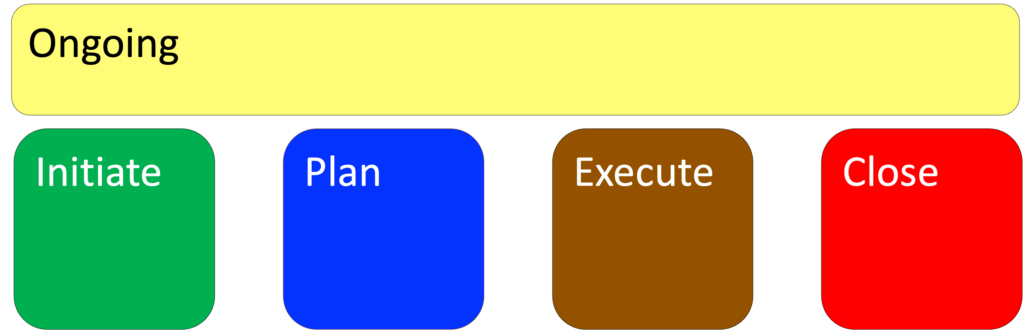
This taxonomy is inspired by the PMBOK® Guide’s focus areas and the Disciplined Agile process goal categories. To be inclusive, synonymous phase titles are included. A project can be described as going through the phases or stages of:
- Way-of-Working (Ongoing). These activities are core disciplines that span the life of the project.
- Initiate (Start-Up, or Concept). The activities undertaken to establish the project’s foundational elements.
- The activities that establish expectations for scope, schedule, and cost, as well as define how the project will be managed.
- Execute (Build, Construct, or Create). The activities to deliver value or create the product, service, or result.
- Close (Transition or Implement). The activities related to the final acceptance of the project’s outcomes and its administrative closure.
Every project is unique, and context matters. Consequently, how practices are carried out and the formality of the artifacts will vary based on multiple factors. The project type, regulatory or contractual constraints, and organizational culture and expectations are some primary drivers.
Way-of-Working
Way-of-working is not a phase; it is the work performed throughout the project. The intensity and importance of these activities will vary throughout the lifecycle. Primary activities and artifacts are listed below, but this list is not exhaustive.
Stakeholder Engagement and Communications
Effective stakeholder management is a key to project success. Project managers begin working with stakeholders on the first day and continue until the project is finished. The processes are identifying, assessing, engaging, and monitoring stakeholder engagement. The stakeholder register is the primary artifact.
Stakeholders are engaged through communications. The management plan outlines the types, frequencies, and key messages to be communicated to stakeholders and other constituencies.
Risk
Risks are future events that present opportunities or threats. If they are not actively managed, it is less likely that the opportunities will be realized and that the threats will be avoided or mitigated. The primary processes are to identify, assess, plan responses, implement responses, and monitor. The risk register is the primary artifact.
Issues and Actions
Issues and actions are identified items that need to be addressed. Managing these items is an essential “housekeeping” task. Issues represent concerns, while actions are tasks that must be completed. Both should be tracked in a register and actively overseen. The issues and action item log is the primary artifact.
Initiate Phase
The objective of the initiate phase is to clearly define the project goals and outcomes. The project sponsor, owner, senior management, and governance organizations should play significant roles to ensure the project aligns with the organization’s strategy and needs. Engaging the project manager early is preferred but not required.
The starting point for the initiate phase is an approved business case or similar funding approval document. For large infrastructure projects, this phase may take years. For small projects, it may be days or weeks.
The primary output of the initiate stage is the project charter or a similar document. The charter serves as a critical foundational document that establishes a shared understanding between the requesting and delivering parties. It elaborates on and refines the objectives, defines success or acceptance criteria, and sets initial scope, schedule, and cost parameters.
Plan
The goal of the planning phase is to create artifacts that guide the rest of the project. Planning is more than just creating documents; it sets expectations. As Eisenhower said, “Plans are useless, but planning is indispensable.” The process of evaluating what needs to be done, how to do it, exploring options, identifying risks, and recognizing interdependencies is crucial. However, we must also recognize that even the best plans often change due to real-world factors.
The project type, approach, and multiple other factors will influence the preferred planning process, artifacts, and deliverables. At a minimum, the project’s scope, schedule, cost/budget, and project management plan should be documented.
The project management plan, or a similar document, is the opportunity to describe how the project will be executed and managed. The project approach, guidelines, management reviews, stakeholder and communication management, and performance reporting are among the critical components.
Planning Predictive Projects
Predictive methodologies generally have established processes for defining scope, schedule, and cost baselines, which then act as key performance indicators. These measures set initial expectations for the team and stakeholders. To maintain ongoing alignment, any changes to the baseline must follow the approved change management process.
The scope baseline includes the scope statement and work breakdown structure (WBS). The scope statement clearly defines what will be delivered. The WBS decomposes the scope into smaller work packages that are small enough to estimate and assign.
The schedule is derived from the WBS and typically displayed as a Gantt chart, highlighting the critical path. The budget accounts for contingency reserves (known risks) and management reserves (unknown risks).
Planning Agile Projects
Agile projects are planned differently from predictive ones. Agile favors ongoing, iterative planning rather than defining everything upfront. Initially, a product vision along with time and cost expectations must be established. The product vision sets the long-term goals. Since Agile scope is emergent, the investment decision (time and cost) can be set as external constraints.
The product roadmap and backlog are key artifacts for defining the product and scheduling functionality delivery. The product owner should regularly review and update these with stakeholders to ensure ongoing alignment.
The project team plans its upcoming work at the beginning of each iteration. During the planning meeting, they decide what can be completed. The team also reviews and refines product backlog items to ensure they are understood, well-defined, and ready to work on when they enter the iteration.
Planning Hybrid Projects
Hybrid projects lack a standard approach because practices can combine both predictive and agile methods. Therefore, it is necessary to define the practices and understand the project scope, schedule, and cost. The project management plan must also outline how planning will be carried out.
Execution Phase
The execution phase is when the team delivers the product, service, or result that creates value. Every project will have its unique practices, processes, and artifacts. In addition to the ongoing activities, the primary activities for the execution phase include:
Performance Measurement and Status Reporting
PMI research found that establishing and tracking performance measures improves the chances of project success. Performance management is broadly defined as comparing planned versus actual performance and taking appropriate actions. Monitoring scope, schedule, and cost are the standard metrics, but others may be equally important.
Status reporting involves regularly updating stakeholders about project performance. The format, frequency, method, and details can vary depending on the approach. Agile projects prioritize transparency and use “information radiators” to show progress. Predictive projects follow specific, established formats and metrics.
Change Management
Change management is a broadly defined process. The typical steps include identifying, logging, assessing, making decisions, communicating, and verifying. The specific practices, processes, and artifacts will vary.
Close Phase
The primary activities of the closing phase are delivering or transitioning the project outcomes to the customer and completing administrative steps to close the project. This may include a formal review and acceptance of the outcomes, transitioning to operations, returning equipment, releasing the team, closing contracts, and finalizing project financials.
© 2025, Alan Zucker; Project Management Essentials, LLC
See related articles:
- Back to Basics, Part 1: State of the Union
- Back to Basics, Part 2: Principles
- Back to Basics, Part 3: The Approach
- Gantt 101: Building a Better Project Schedule
- Planning is a Process, Not an Outcome
- Project Frameworks: Understand the Choices
- The Project Charter Lays the Foundation
- Unlock the Power of the Project Management Plan
To learn more about our training and consulting services or subscribe to our newsletter, visit our website: http://www.pmessentials.us/.
Image generated by ChatGPT